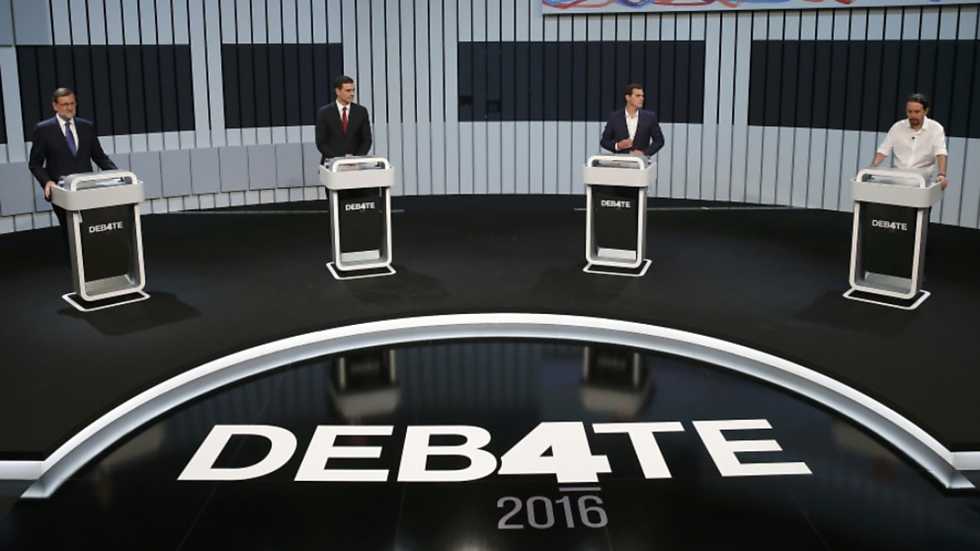
Time to form a government
Once the Spanish citizens have voted, it’s time to form a government. In the Spanish system, the different parties decide who will be the one that leads the country. For a party to govern, it must count with an absolute majority (more than a half of the seats must support it). During the bipartidism, this process was very simple: either PP or PSOE had more than a half of the seats and that was the winning party. But after this election everything changed, since no party had an absolute majority (175 seats), the bigger ones had to present their investiture and negotiate the support of the rest of the parties. If no party receives more than 175 yes, they vote again but this time is enough to have more yes’ than no’s (this time, blank votes are important).
As we saw in the previous post, the result was the following: 123 seats for PP, 90 for PSOE, 69 for Podemos and 40 for Ciudadanos. The four parties were divided into two blocks: left and right, so the right block (PP) would try to form a majority and so would the left block (PSOE and Podemos); Ciudadanos, who tried to stay in the center, could form a majority with both PSOE and PP. The idea was simple, the biggest party in the block would govern and the other one would support in exchange of some power (ministers, for example). Since no block had a majority and not even more yes’ than no’s, the only solution was to repeat the election and hope to unlock this political situation.
June 2016: the rematch
Repeating elections was not the only solution. The left block could have tried to form a government and PSOE could have voted blank to let PP have a simple majority with the support of Ciudadanos, but Podemos was not interested in the first option (the wanted to repeat elections to try to overcome PSOE and be the party that tried to form a government and not the one just supporting) and PSOE was not interested in the second option (Pedro Sánchez, its leader, refused to support a the European party with more cases of corruption).
For achieving the sorpasso (Italian concept to describe a political overtaking), Podemos joined Izquierda Unida (United Left), another anti-capitalist party to see if altogether could have more seats than PSOE. But it didn´t go as planned and the result of the second election was: 137 seats for PP, 85 for PSOE, 71 for Podemos and 32 for Ciudadanos. Podemos got closer to PSOE but it was not enough to overcome them, and the right block was closer to the absolute majority (from a sum of 163 in 2015 to 169 in 2016).
Despite the increase in the right block power (by six seats) and the decrease of the left block power (by three seats), PP still needed PSOE’s blank vote to be able to govern. The alternative solution by then, was going to third elections, which would mean a huge public cost and an international sample of political lock and country instability.
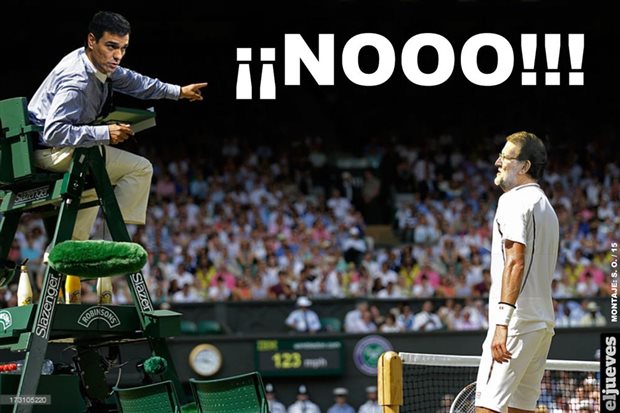
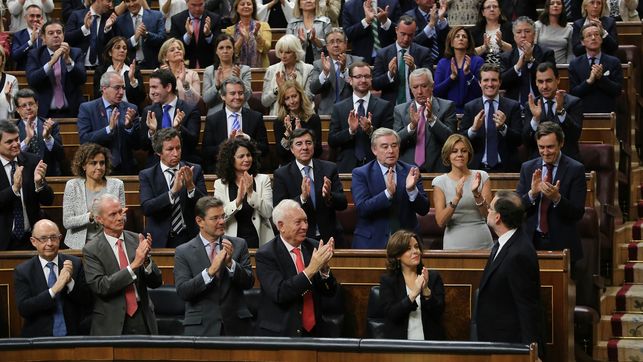
Pedro Sánchez kept saying that he would never let PP get the power again. PSOE’s basis disagreed with him, defending that the party had to put Spain first and allow PP to govern Spain. An internal vote resulted in its leader being ceased, the party voting blank and Mariano Rajoy being reelected as the President of Spain.
But that moment was not the end of Mr. Sánchez’s political career, in fact, he would end up becoming the President of Spain. But that will be explained on our next post.
Me encanta la idea de hacer un blog sobre la situación política actual española, es muy interesante. No hay excusa,…
I liked the blog, very useful and well done.
Amazing photos!! Thanks, it’s very interesting!!!
 Spanish politics for non Spaniards
Nice blog! I think you didn’t have to explain so back in time but for the rest it was really…